Adho Mukha Virasana
- with bloster supporting body
- 2 blanket,s folded lengthwise, along torso
- 1 blanket, folded lengthwise, between legs, under butt
Adho Mukha Sirsasana
- bolster supporting head
- hands against wall
Uttanasana x2
- butt against wall
- weight on folded arms
Supta Virasana, Supta Baddha Konasana, Supta Swastikasana
- fully supported
- belt for legs
- tiny block under chest
- 2, instead of 1, blanket for head
Matsyasana, supported
- 2 chairs, facing each other
- folded matt on chairs
- 1 bolster across for back body
- blankets for head
- tiny block for chest
- feet completely on wall
- legs straight
Virasana Forward bend
- legs farther apart
- blanket between legs under butt
- fold body both sides, head resting on chair w/ blanket
- lengthen twisting torso side
Salamba Sarvagasana
- chair for support
- bolster and blanket for shoulders & head
- 3 variations: feet on wall, feet in Baddha Konasana, legs off chair
Setu Bandha
- block middle height against wall for feet
- block under sacrum longwise
- maybe bolster or blanket for falling chest
Savasana
Thursday, April 28, 2011

Thursday, April 21, 2011
Pranayama, Another Start

Even though I've been practicing yoga for almost 10 years, I still tackle dedicating myself to a consistent pranayama. Typically, a yogini should not begin practicing pranayama until, I believe, 2+ years of a asana practice has been regulated. So, what have I been doing for the past years, pranayama-wise? Why can't I be a regular "breather"? I decided to start reading a more basic, bare bones pranayama book, "The Yoga of Breath: A Step-by-Step Guide to Pranayama," by Richard Rosen since reading "Light on Pranayama" by: B.K.S. Iyengar was not enabling me to grasp the basic knowledge I needed to practice consistently. Don't get me wrong, Light on Pranayama is a definite must to any serious yoga practitioner, but I find the content to be very complex and detailed for a beginner like myself; I use it often mainly as a reference book. The Yoga of Breath seems like a good starting point for someone who is an absolute beginner and wants to start practicing. Richard Rosen definitely gets to the basics of pranayama and yoga, introducing you to what you need to know about yoga and how to start a practice. Unfortunately, you don't start practicing the actual pranayama breathing until later on in the book, but that's alright because I actually just started, last week, a regular practice, every morning at 6:30 AM. I decided to wake up 30 minutes before I normally do for getting ready for work to practice savasana and breathing deep smooth inhalation and exhalations (Ujayi) for 10 minutes. Unfortunately, I had to take the last few days off since I was rather ill. Richard Rosen strongly suggests writing in a journal for your pranayama practice. Of course, he meant physically writing in a journal, but I decided to blog about my experiences since I do have this yoga blog and have been abandoning it for weeks now. I did write an entry not too long about wanting to start meditating and since I find pranayama to be a great introduction to meditating, I haven't fall too astray from my pursuit! Actually, in the eight-limbed yoga system, you start with a regular asana practice and then pranayama practice followed by withdrawal of the senses, concentration, and meditation which leads to samadhi, enlightenment.
On the right track.
Tuesday, March 8, 2011
Summary of Yoga
A great summary on Yoga I found on Loyola Marymount University in Los Angeles. The school is considering the first Masters of Arts in Yoga Studies program in North America. I hope they do! It would combine my interest in yoga and living in Los Angeles!
About Yoga
Yoga is a practice for optimizing the health of the body and quieting the mind. It includes a variety of activities, including postures (asanas), breathing techniques (pranayama), meditation (dhyana), and lifestyle practices. According to a year 2000 survey, it is estimated that over 15 million Americans currently practice this ancient art.
Yoga comes from the Sanskrit word yuj, which means to yoke, join, or apply. Yoga is usually translated as union, for its methods and practices lead to a profound integration of body, mind, and spirit. The yogic ideal is to achieve complete freedom and authenticity by transcending the limiting structures of the ego-personality (the person we behave as on a normal day) and discovering the true spiritual Self within.
Although the most authoritative root texts on Yoga were written in classical India around the beginning of the Christian era, archaeological evidence from the Indus River valley of present-day Pakistan indicates that some form of yogic meditation was being practiced on the subcontinent at least two thousand years earlier.
Classical Yoga of Patanjali
Patanjali is believed to have lived sometime between 200 BCE and 450 CE. He is sometimes called the "founder" of Yoga, but in reality Patanjali's chief contribution was to compose an organized and succinct presentation of a system of thought and practice which had already been around for many centuries before his time. He summarized the essentials of yoga practice in a highly condensed document composed of 195 aphorisms, which has become known as the Yoga Sutra. Today this elegant text continues to be revered by scholars and practitioners alike as the most coherent and authoritative outline of the fundamental principles of Classical Yoga.
The Yoga Sutra begins by defining yoga as the liberation of the "Seer" by bringing about the control of the incessant modifications of the mind. In service of this goal, Patanjali presents a basic psychology of mind and describes how mental activity can be mastered and therefore quieted or stilled through the application of contemplative practice. In the first chapter alone, over twenty techniques are mentioned which can help bring about quietude and clarity of mind. He continues by describing the deepening stages of meditation which ultimately lead to self-realization and spiritual freedom. In the remaining three chapters, Patanjali describes the eight limbs of spiritual practice or ashtanga-yoga, the supranormal capacities or siddhis that naturally arise through contemplative practice, and finally the supreme goal of spiritual self-sufficiency or kaivalya. Understanding the Yoga Sutra is vital for any serious practitioner of Yoga.
Yoga and Ethics
The foundation for successful Yoga practice begins with application of basic ethical principles called yamas or "restraints." These include non-violence, truthfulness, non-stealing, sexual restraint, and non-possessiveness. Adoption of this ethical code of conduct is complemented by the niyamas or "observances," which include contentment, purity, austerity, self-study, and spiritual devotion. The yamas constitute core qualities which promote healthy social relationships, while the niyamas are personal habits which are conducive towards an individual's spiritual development. These basic lifestyle principles form the essential foundation of Pata?jali's Ashtanga Yoga system. These practices are undertaken to promote the kind of positive social and personal developments which are needed for the practices of asana, pranayama, and meditation to become fully fruitful and effective.
Types of Yoga
The yoga of Patanjali's Yoga Sutra is sometime referred to as raja-yoga or the "royal" yoga. But this highest yoga includes within it several more specific types of yoga, each with its own emphasis. The yoga which Americans are most familiar, which consists of various postures and stretches designed to perfect the physical body, is known as hatha-yoga. A specialized extension of this kind of yoga, which involves the manipulation of the inner energy pathways of the body-mind complex is known as kundalini-yoga. Bhakti-yoga is the yoga of ecstatic religion devotion, while the path which focuses on the acquisition of higher spiritual knowledge is called jnana-yoga. The path of selfless action in the world which Krishna teaches to Arjuna in the Bhagavad-Gita is known as karma-yoga. Each of the different approaches to yoga practice has developed in order to suit the spiritual needs of individuals of different dispositions and capacities.
Yoga and Religion
Yoga is a set of spiritual practices but in itself is not an institutionalized religion, per se. Hinduism is related to yoga through a common recognition of the Vedas as an authoritative source, and both Buddhism and Jainism share many of the core values of the Yoga tradition. But Classical Yoga is best understood as a system of spiritual practice, rather than a particular religion. Being non-sectarian in its essence, yoga represents a body of practices that may be fruitfully taken up by anyone who is serious about their spiritual development, regardless of their individual religious affiliation.
Although some people practice yoga out of devotion to a guru, there are others who follow their own guidance. Although yoga does not necessarily require belief in a Creator as we understand God in the traditional Western religious sense, the Yoga Sutra advocates devotion to Ishvara or the "Lord" who is described as an ultimate being forever unafflicted by worldly concerns. Whether this Lord is understood as God Almighty or as the yogic ideal of the liberated "Seer," the decision about how to conceptualize Ishvara is very personal one. By remaining deliberately ambiguous and non-dogmatic about such ultimate theological issues, the Yoga tradition establishes itself as a positive proponent for individual spiritual development for persons of all religious backgrounds and creeds.
About Yoga
Yoga is a practice for optimizing the health of the body and quieting the mind. It includes a variety of activities, including postures (asanas), breathing techniques (pranayama), meditation (dhyana), and lifestyle practices. According to a year 2000 survey, it is estimated that over 15 million Americans currently practice this ancient art.
Yoga comes from the Sanskrit word yuj, which means to yoke, join, or apply. Yoga is usually translated as union, for its methods and practices lead to a profound integration of body, mind, and spirit. The yogic ideal is to achieve complete freedom and authenticity by transcending the limiting structures of the ego-personality (the person we behave as on a normal day) and discovering the true spiritual Self within.
Although the most authoritative root texts on Yoga were written in classical India around the beginning of the Christian era, archaeological evidence from the Indus River valley of present-day Pakistan indicates that some form of yogic meditation was being practiced on the subcontinent at least two thousand years earlier.
Classical Yoga of Patanjali
Patanjali is believed to have lived sometime between 200 BCE and 450 CE. He is sometimes called the "founder" of Yoga, but in reality Patanjali's chief contribution was to compose an organized and succinct presentation of a system of thought and practice which had already been around for many centuries before his time. He summarized the essentials of yoga practice in a highly condensed document composed of 195 aphorisms, which has become known as the Yoga Sutra. Today this elegant text continues to be revered by scholars and practitioners alike as the most coherent and authoritative outline of the fundamental principles of Classical Yoga.
The Yoga Sutra begins by defining yoga as the liberation of the "Seer" by bringing about the control of the incessant modifications of the mind. In service of this goal, Patanjali presents a basic psychology of mind and describes how mental activity can be mastered and therefore quieted or stilled through the application of contemplative practice. In the first chapter alone, over twenty techniques are mentioned which can help bring about quietude and clarity of mind. He continues by describing the deepening stages of meditation which ultimately lead to self-realization and spiritual freedom. In the remaining three chapters, Patanjali describes the eight limbs of spiritual practice or ashtanga-yoga, the supranormal capacities or siddhis that naturally arise through contemplative practice, and finally the supreme goal of spiritual self-sufficiency or kaivalya. Understanding the Yoga Sutra is vital for any serious practitioner of Yoga.
Yoga and Ethics
The foundation for successful Yoga practice begins with application of basic ethical principles called yamas or "restraints." These include non-violence, truthfulness, non-stealing, sexual restraint, and non-possessiveness. Adoption of this ethical code of conduct is complemented by the niyamas or "observances," which include contentment, purity, austerity, self-study, and spiritual devotion. The yamas constitute core qualities which promote healthy social relationships, while the niyamas are personal habits which are conducive towards an individual's spiritual development. These basic lifestyle principles form the essential foundation of Pata?jali's Ashtanga Yoga system. These practices are undertaken to promote the kind of positive social and personal developments which are needed for the practices of asana, pranayama, and meditation to become fully fruitful and effective.
Types of Yoga
The yoga of Patanjali's Yoga Sutra is sometime referred to as raja-yoga or the "royal" yoga. But this highest yoga includes within it several more specific types of yoga, each with its own emphasis. The yoga which Americans are most familiar, which consists of various postures and stretches designed to perfect the physical body, is known as hatha-yoga. A specialized extension of this kind of yoga, which involves the manipulation of the inner energy pathways of the body-mind complex is known as kundalini-yoga. Bhakti-yoga is the yoga of ecstatic religion devotion, while the path which focuses on the acquisition of higher spiritual knowledge is called jnana-yoga. The path of selfless action in the world which Krishna teaches to Arjuna in the Bhagavad-Gita is known as karma-yoga. Each of the different approaches to yoga practice has developed in order to suit the spiritual needs of individuals of different dispositions and capacities.
Yoga and Religion
Yoga is a set of spiritual practices but in itself is not an institutionalized religion, per se. Hinduism is related to yoga through a common recognition of the Vedas as an authoritative source, and both Buddhism and Jainism share many of the core values of the Yoga tradition. But Classical Yoga is best understood as a system of spiritual practice, rather than a particular religion. Being non-sectarian in its essence, yoga represents a body of practices that may be fruitfully taken up by anyone who is serious about their spiritual development, regardless of their individual religious affiliation.
Although some people practice yoga out of devotion to a guru, there are others who follow their own guidance. Although yoga does not necessarily require belief in a Creator as we understand God in the traditional Western religious sense, the Yoga Sutra advocates devotion to Ishvara or the "Lord" who is described as an ultimate being forever unafflicted by worldly concerns. Whether this Lord is understood as God Almighty or as the yogic ideal of the liberated "Seer," the decision about how to conceptualize Ishvara is very personal one. By remaining deliberately ambiguous and non-dogmatic about such ultimate theological issues, the Yoga tradition establishes itself as a positive proponent for individual spiritual development for persons of all religious backgrounds and creeds.
Thursday, February 10, 2011
Meditation, A Start

I started out this yoga blog as a way to express my process and evolution in practicing yoga. Recently, I started to write notes about the practice of yoga since I'm enrolled in an advanced studies yoga program. I wanted to start writing my thoughts but didn't think that type of writing would fit with my current factual writing I started. Now, I realized that I'm going to start writing both, the journalistic and the latter, in this blog.
I practice and read about yoga fluently. I attempted some practices in pranayama that have yet to stick. The one journey I have yet to start is meditation. There's no real reason I haven't even attempted to start a meditation practice. Maybe it's because I felt like pranayama practice is a form of meditation. But it's not. I mean it is. But it's not. I need to meditate, meditate. Sit in siddhasana, close my eyes and focus on nothing. I think this would help and assist me in my yoga practice/studies and in my life. Since this is new territory, I will not act like I know a lot about the subject because to be quite honest, I don't. Or at least I think I don't. I don't even know what types of meditation there are or whose books to read. I found a "Meditation for Dummies" book, maybe I'll start there. Maybe I'll start today. Either way, I start incorporating this practice, trying to meditate and learning about meditation. I already meditate on my life and actions constantly and I have noticed that this attention is very beneficial to my well being. I'm a conscious being who is attentive to all her actions and thoughts. Now I'm curious as to what will happen when I set aside time to just look within. Quiet. Still. Calm. The journey begins.
Wednesday, January 19, 2011
The Yamas: Expounded

In continuation of my previous blog entry, The Yamas, I thought I would include a worksheet from my Advanced Yoga Studies program that I found very helpful on how to incorporate the Yamas into life. These are not my own words, they are directly from the worksheet: This comment is an example of Asteya!
Ahimsa: Non-violence
Thought (Mental-Baudhika)
- What is destructive to happiness, peace of mind, dreams, contentment.
- Look at violent thoughts: anger, jealousy, envy, self-criticism, etc.
- Verbal Violence longer-lasting than physical. Damages self as well as others.
- Consider impact of words before speaking.
- Includes violence against others and self.
- Consider effects of self-destructive behavior. Usually begins as mental attitude.
Satya: Non-lying, Truthfulness
Thought (Mental-Baudhika)
- Seek out own truth without dogma or judgment of others.
- Know that all truth is subject to bias of body and mind.
- Speak with listener in mind.
- Speaking truth means it is a dialog.
- Be as unbiased a vehicle for the teachings as possible.
- Be aware of how body correlates to internal states. Bring unity to thought, word and deed to communicate truth.
Asteya: Non-stealing
Thought (Mental-Baudhika)
- Refrain from taking anything that is not yours, includes someone else's happiness, special moment, ideas, way of life, beliefs
- Do not pretend someone else's words, ideas, thoughts are your own.
- OK to borrow language to effectively communicate.
- Give credit to originator of your words.
- Take as little as possible from environment to maintain balance. Bring balance to body by not forcing an asana you have not earned.
Brahmacharya: Non-sensuality
Thought (Mental-Baudhika)
- Become the master of your own creative force.
- Harness and direct the energy of creation.
- Keep energy in balance while giving it proper expression.
- Feel the bliss of being one with creation; part of Life.
- Choose words carefuly with respect for how they affect others.
- Use language to discover the harmonious expression of creative drives.
- Listen as well as speak.
- Find balanced way to express creative and procreative drives, depending on time, place and position.
Aparigraha: Non-greed
Thought (Mental-Baudhika)
- Release thought patterns which no longer serve you.
- Take into your consciousness only what is needed and keep it there only as long as it is useful.
- Communicate clearly and concisely.
- Be a good listener.
- Be less greedy with thoughts and words so that you can really listen to the teachings of Life.
- Be quiet enough to hear.
- Evaluate what you need versus what you want. This subjective and dynamic.
- In practice, refrain from taking too much from asana.
- Pain and suffering which has not yet occurred can and is to be avoided.
Tuesday, November 23, 2010
Chakras

The body consists of a network of energy channels (nadis) where energy (prana) circulates. One channel runs along the axis of the body, from the base of the spine to the crown of the head. In the ordinary individual this central channel of subtle energy is said to be mostly inactive. One purpose of Hatha Yoga is to clear this channel of any obstructions. The energy then can flow freely leading to better health and higher states of consciousness. When this channel is activated it sets the six chakras in motion. Chakras are psychoenergetic centers which are aligned along the central channel.
The Six Chakras
Muladhara
"Root Prop"
Location: at the base of the spine.
This center is connected with elimination as well as fear.
Earth
Adrenal
Center of stability
Security
Sense of self
Svadhisthana
"Own Place"
Location: at the genitals/sacrum
This center is connected with urogenital functions, but also with desire.
Water
Taste
One's own
Manipura
"Jewel City"
Location: at the naval/solar plexus
This center distributes the life force to all parts of the body and is especially involved in the digestive process and willpower.
Fire
Sight
Anahata
"Unstruck"
Location: in the middle of the chest.
This center is also called the "heart chakra." is the place where the "unstruck" or inner sound can be heard in meditation. It is also linked with love.
Air
Touch/skin
Thymus
Vishuddha "Pure"
Location: at the throat
This center is associated with speech and greed.
Ajna
"Command"
Location: between eyebrows/third eye
This center is the contact place for the guru's telepathic work with disciples. Also associated with the experience of higher states of consciousness.
Sahasrara
"Thousand-spoked"
Location: crown of the head
Special chakra is associated with higher consciousness, notable ecstatic state.
Beyond all elements
Hypothalamus
1000 petal lotus
Yoga Sutras: Citta Vrtti
 Sutra 1.6:
Citta Vrtti (movements in the consciousness) which cause pleasure or pain are:
Pramana: clear perception
Viparyaya: misperception
Vikalpa: imagination
Nidra: deep sleep
Smrti: memory
Sutra 2.3
The five causes of chitta vrrti creating pain (klesah):
Avidya: ignorance
Asmita: ego
Raga: attachment
Dvesa: aversion
Abhinivesah: love of life; fear of death
"As breeze ruffles the surface of a lake and distorts the images reflected therein, so also the chitta vrtti disturb the peace of the mind. The still waters of a lake reflect the beauty around it. When the mind is still, the beauty of the Self is seen reflected in it. The yogi stills his mind by constant study and by freeing himself/herself from desires. The eight stage of Yoga teach him/her the way." - BKS Iyengar
Friday, October 22, 2010
The Niyamas

The niyamas are the second limb of yoga. They are rules of conduct towards oneself that consist of certain disciplines which are both physical and mental. These individual ethical observations that can help harmonize our inner lives. They are:
1. Saucha: cleanliness; both inner and outer
2. Santosa: contentment
3. Tapas: discipline
4. Svadhyaya: self-study
5. Ishvara Pranidhana: self-surrender
The niyamas, like the yamas, can be practiced both in our daily lives and also in our yoga practice. For example, finding time to practice is difficult. You require discipline (tapas) to make time and practice your asanas. This in turn cleanses your body (saucha) making you feel content (santosha) with your practice. Since you are practicing more frequently, you make more accurate observations (svadhyaya) on your asanas and surrender (ishvara pranidhana) yourself to the study of yoga.
When your living space and the food you eat is clean (sauca), you can concentrate and focus more clearly. Being discontent only breeds envy and unhappiness, whereas practicing an attitude of gratitude (santosa) results in living a happy existence. Discipline (tapas) is everything in yoga from disciplining to practice the asanas, the yoga sutras, and becoming a better human being. Studying (svadhyaya) your actions and how you react to situations will give a clearer understanding why you do the things you do and how to avoid conflict by merely reacting. Knowing that the world is more than oneself (isvara pranidhana) is spiritually enlightening.
The Yamas

The Yamas are the first limb of yoga. They are moral rules for society. If followed, they bring peace and harmony in the world. The Yoga Sutra of Patanjali offers these five Yamas (Sutra 2.30):
1. Ahimsa: non-violence
2. Satya: non-lying
3. Asteya: non-stealing
4. Brahmacharya: moderation
5. Aparigraha: non-greed
2. Satya: non-lying
3. Asteya: non-stealing
4. Brahmacharya: moderation
5. Aparigraha: non-greed
Each of the yamas manifests on three levels:
- Mental: mindfulness of what we think
- Verbal: mindfulness of what we say
- Physical: mindfulness of what we do
Below are examples from my advanced studies class on how to practice and contemplate the yamas.
Sutra 2.35 Ashimsa: In the presence of one practicing ahimsa, hostility can not exist.
- Example of mental ashimsa - When I think negative thoughts about someone, I will take time to notice why I am thinking this way, striving to understand that the person behaves the way he does because of previous life experience.
- verbal ashimsa - When someone insults or criticizes me, how do I feel and why do I allow those words to affect me? Can I ignore them, or investigate why they are being said?
- physical ashimsa - When I witness violence or become afraid, can I use discernment to decide for myself if and to what extent I should be involved?
Sutra 2.36
2. Satya: Truthfulness secures confidence in the results of an action
- mental satya - I will be honest with myself instead of thinking I should be feeling another way.
- verbal satya -
- physical satya - When I
Sutra 2.37
3. Asteya: Prosperity comes to one who does not steal.
Sutra 2.38
4. Brahmacharya: When practicing non sensuality, vitality is obtained.
Sutra 2.39
5. Aparigraha: When no longer grasping for things, we discover why we are born.
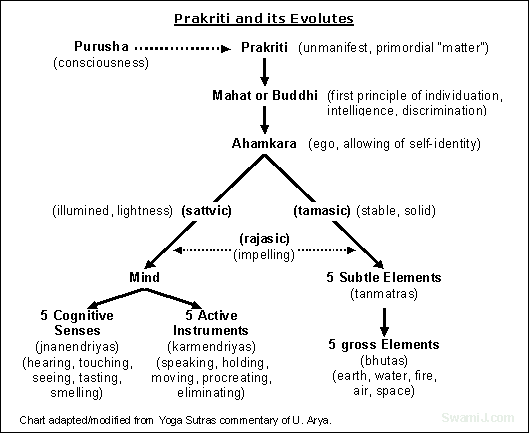
More on Sankhya Philosophy
Sankhya is a dualistic philosophy. The dualism is between the self and matter whereas in the West, its between mind and body. Sankhya has their own version on how they think life emerged in the universe similar to "The Big Bang Theory." They regard the universe consisting of two realities:

Purusha is the Transcendental Self or Pure Consciousness. It is absolute, independent, free, imperceptible, unknowable, above any experience and beyond any words or explanation.
Prakriti is the first cause of the universe of everything (expect Purusha). Prakriti evolves itself successively into twenty four tattvas (principles). It's composed of three characteristics (gunas):
- Sattva: a template of balance or equilibrium; characterized by purity, luminosity, lightness, harmony and the production of pleasure.
- Rajas: a template of expansion or activity; endeavor, energy, movement, producing pain. Impel and energizes overcoming stagnation.
- Tamas: template of inertia or resistance to action; stability, stagnation, dullness, darkness, stasis, stupor.
Thursday, October 21, 2010
Eight Limbs of Yoga
Yoga isn't exclusively a physical practice, it is also a mental and spiritual one. The postures (asanas) are one of 8 components, stages of yoga, know as Ashtanga Yoga. More of each limb later.


Subscribe to:
Posts (Atom)
Iyengar Yoga Sequencing
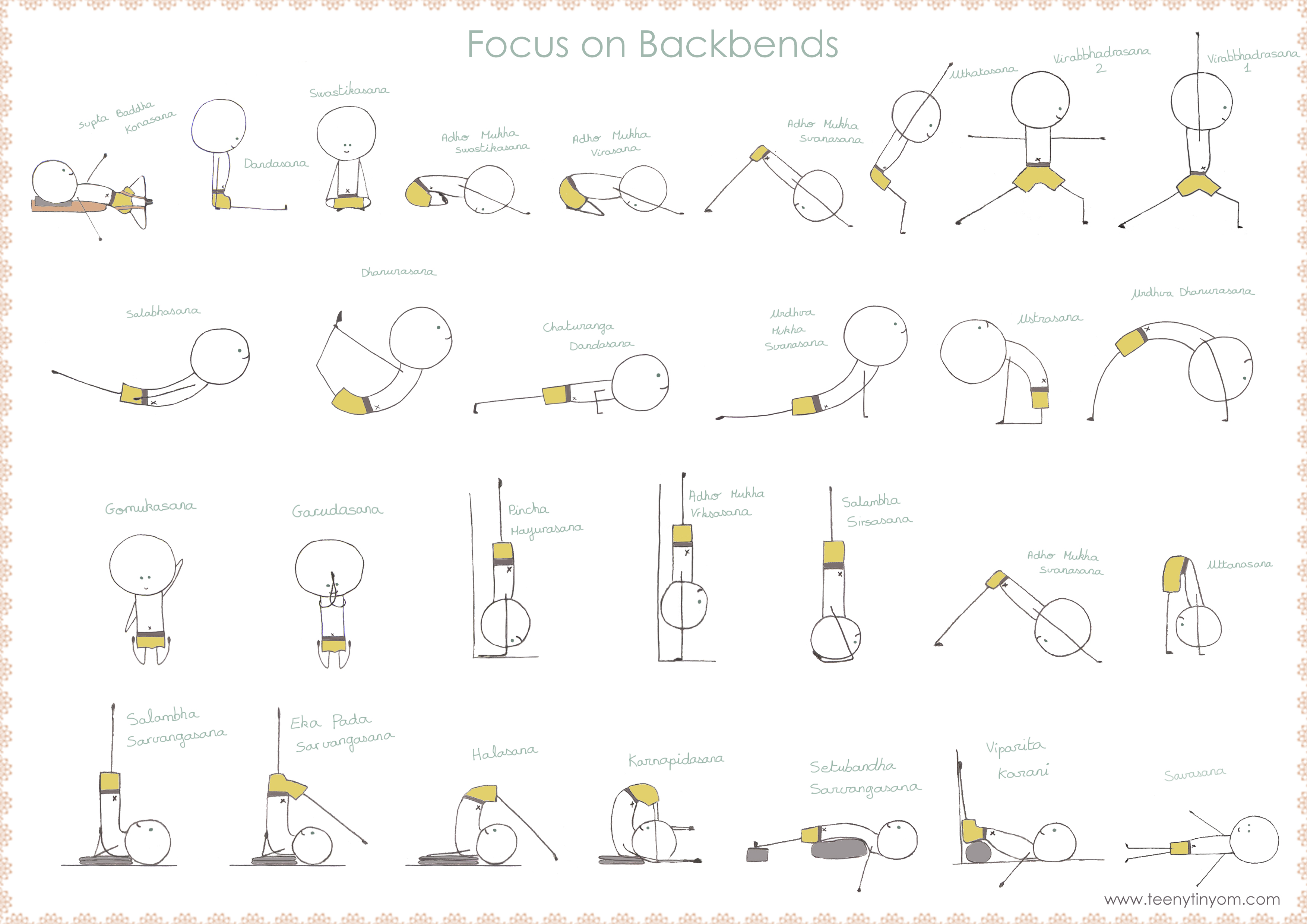
While looking for an image for this blog post, I stumbled upon this excellent yoga blog with great sequences and cute drawings! I alrea...
-
 Alright, I feel like going back to the beginning of The Tree of Yoga, (Note: I used "tree" in the blog title because of my nickna...
 -
 I'm trying to start practicing 6 days a week, but its hard since I work so far away and don't always get a chance to stop by home t...