Standing on my head in Sirsasana, I started to think upon being happy in the here and now. This statement has been said time and time again. I understand that. But as I have more time on my hands these days, my mind panics and dreams of a better place, a better time, a better anything. Will this be my key to happiness and a meaningful existence? Or will this "better" like anything else, succumb to the same ups and downs that make life confusing and exhausting? When do I have to change route in my life? Am I better off doing something completely different or must I make it work? Am I over thinking all of this? I remember my yoga teacher saying that confusion is good because you're taking control over your life by restating the rules. You are confused and so then you seek information on your own terms; nobody else's. Life is so short and sometimes feels like it's hanging by the thread. Shouldn't we seek meaning or do we have to worry about finding a job to pay the bills so that we can eat and have a place to sleep? If I'm happy, am I just comfortable? Maybe there's a fine line between seeking more meaning and just simply complaining. Be happy, but always strive to do your best. Life is taxing, how can we ever be happy in that stressful now? I guess situations can always be worse and you need an attitude of gratitude. Those overlooked pleasures can be taken away and that can be regretted. Maybe the more time on my hands, the more I contemplate because idle hand are the devil's playthings.
Wednesday, January 18, 2012
Be Happy Now
Standing on my head in Sirsasana, I started to think upon being happy in the here and now. This statement has been said time and time again. I understand that. But as I have more time on my hands these days, my mind panics and dreams of a better place, a better time, a better anything. Will this be my key to happiness and a meaningful existence? Or will this "better" like anything else, succumb to the same ups and downs that make life confusing and exhausting? When do I have to change route in my life? Am I better off doing something completely different or must I make it work? Am I over thinking all of this? I remember my yoga teacher saying that confusion is good because you're taking control over your life by restating the rules. You are confused and so then you seek information on your own terms; nobody else's. Life is so short and sometimes feels like it's hanging by the thread. Shouldn't we seek meaning or do we have to worry about finding a job to pay the bills so that we can eat and have a place to sleep? If I'm happy, am I just comfortable? Maybe there's a fine line between seeking more meaning and just simply complaining. Be happy, but always strive to do your best. Life is taxing, how can we ever be happy in that stressful now? I guess situations can always be worse and you need an attitude of gratitude. Those overlooked pleasures can be taken away and that can be regretted. Maybe the more time on my hands, the more I contemplate because idle hand are the devil's playthings.

Wednesday, November 30, 2011
Geeta Sequence: Week Two
- Samasthiti
- Urdhva Hastasana
- Urdhva Baddhanguliyasana
- Namaskarasana
- Urdhva Namaskarasana from Urdhva Hastasana
- Utthita Hasta Padasana
- Parsva Hasta Padasana
- Utthita Trikonasana
- Virabhadrasana II
- Utthita Parsvakonasana
- Parsvottanasana (Standing with concave back hands on waist)
- Parsvottanasana (Hands down, head down)
- Prasarita Padottanasana (Concave back)
- Dandasana
- Urdhva Hasta Dandasana
- Padangustha Dandasana
- Ardha Halasana (swinging from floor to rest feet on wall)
- Paschimottanasana
- Savasana
In the second week, Geeta is introducing Virabhadrasana II (which acts as a preparatory), Uthitta Parsvakonasana, and Ardha Halasana. I still do not understand why Ardha Halasana would be introduced to a beginner in the first week; I find that pose extremely intense. I did observe the beginner class attempting that pose and it was successful. I guess I would just be intimated to teach that pose in my own class for the second week.
I noticed, while using props after classic asana was practiced, that my legs sway forward in the standing asanas instead of staying parallel to the wall. This revelation was gained from the amount of time we spend in class on Prasarita Padottanasana. My teacher said that when we are more flexible, as I am, we tend to shift the legs back in Prasarita Padottanasana. Through this discovery, I concentrated my attention on the aligning of the legs in my standing poses. And since standing is the most prominent component to these beginning weeks of the sequences, I had an opportunity to explore the swaying of my legs.
Tuesday, November 29, 2011
Life Is as Life Is.

"Life is as life is and is as it ought to be. If it were not as it ought to be, it would be other than it is. But it's not. Therefore, life is as it ought to be. It will change when it ought to change. This may sound circular to you, and from the Western logical tradition, it is indeed circular. But the truth is not limited to Western logical tradition. It is as it is. the question is, "Why is it as it is?" Because it is a drama to teach us."
- Goswami Kriyananda "Beginner's Guide to Meditation"
Light on Yoga: Week One & Two
- Tadasana
- Vrksasana
- Utthita Trikonasana
- Utthita Parsvakonasana
- Vibradrasana I
- Vibradrasana II
- Parsvottanasana
- Salamba Sarvangasana
- Halasana
- Savasana
Wednesday, November 23, 2011
Geeta Sequence: Week One
Throughout my ten year yoga practice, it was only within the last year that I decided to enroll in an Advanced Yoga Studies and Teacher Training course. Finally, my first teacher decided to open a school. This decision was wonderful for someone like me who feels like they can only enroll in a program by a Certified Iyengar Teacher. During my time in the program, there was a plethora of information that I tried to write on this blog and I still feel discontent with the amount of that I have written. I have realized, especially since practicing yoga, that if you want to fully immerse yourself within a subject, you need practice...ALL THE TIME! I was practicing postures 90 minutes a day during the workweek and then stopped altogther after getting laid off of work. Currently, I find myself struggling to practice so frequently. Maybe it's also because I started exploring the yogic texts, pranayama, and meditation. I know for certain that I need to establish a daily focus within the practice. A few weeks ago I began organizing Geeta's weekly yoga sequences from her "Preliminary Course Book" and realized that I have never followed the sequences in "Light on Yoga." Perhaps, I can practice these sequences and write about them. The only issue I have is whether or not to practice both at the same time or just focus on one guide. Yesterday, I decided to start Geeta's sequence structure again.
Geeta's Week One

Geeta's Week One
- Samasthiti
- Urdhva Hastasana
- Urdhva Baddhanguliyasana
- Namaskarasana
- Urdhva Namaskarasana from Urdhva Hastasana
- Utthita Hasta Padasana
- Parsva Hasta Padasana
- Utthita Trikonasana
- Parsvottanasana (Standing with concave back hands on waist)
- Prasarita Padottanasana (Concave back)
- Dandasana
- Urdhva Hasta Dandasana
- Padangustha Dandasana
- Paschimottanasana
- Savasana

Tuesday, November 8, 2011
Almost Certified

Even though I've continued logging my yoga sequences in this blog, I realized I feel astray detailing my thoughts and acquired knowledge. It's been awhile since doing the latter. I'm sure the main reason is because I completed the Advanced Yoga Studies 150 hour program at the Bhavana Institute for Yoga and Ayurveda. The program was well-rounded, informative and filled with a delightful group of teachers who offered encouragement and support. I knew yoga encompassed more than the asana and pranayama practice, but never could understand anything outside of those two subjects like: the yoga sutras, the Bhagavad Gita, and yogic philosophy. Even though I walked away with new knowledge and insight, I still feel there's more to explore in the wonderful world of yoga! And now I'm currently finishing the 50 hours in order to be a certified yoga teacher. Within those 50 hours, I am apprenticing a beginner class, studying for an anatomy class, attending workshops and then I have to actually teach a class for a total of ten hours. I have yet to teach my own class. I don't understand how anyone does since this is a huge challenge for me. I lacked, and may still, in confidence within myself and ability which will get me nowhere but at a standstill in life. I need to work towards being more confident in myself (not cocky) and my yoga. I may not be the best, but I dedicate so much time, practice, and energy into yoga. I'm still unsure of sequences or the proper terminology when teaching, I guess that is another practice I'll over take.
Thursday, November 3, 2011
Standing (Twist) Inversion Sequence

Adho Mukha Svanasana
- with hands on blocks against wall
- with heels on blocks against wall
Utthita Trikonasana
- heel against wall
Utthita Parsvakonasana
- blocks under groin
- blocks under thigh
Parsvottanasana
- hands on block, concave back
Prasarita Trikonasana
- 2 blocks
Adho Mukha Svanasana
Salamba Sirsasana
Adho Mukha Svanasana
Salamba Sarvangasana
- with Eka Pada variations
Halasana
- with chair
Paschimottasana
Savasana
- height under knees
Wednesday, November 2, 2011
Restorative Sequence
Supta Baddha Konasana
Supta Virasana
Adho Mukha Virasana on a bolster
Adho Mukha Svanasana with head supported
Uttanasana with blocks
Sirsasana
Chair Viparita Dandasana
Chair Sarvangasana
Chair Halasana
Setu Bandha Sarvangasana with support
Viparita Karani
Savasana
Supta Virasana
Adho Mukha Virasana on a bolster
Adho Mukha Svanasana with head supported
Uttanasana with blocks
Sirsasana
Chair Viparita Dandasana
Chair Sarvangasana
Chair Halasana
Setu Bandha Sarvangasana with support
Viparita Karani
Savasana
Thursday, October 13, 2011
Yoga Sequencing
Notes taken from www.bradpriddy.com
Proper sequencing of asanas within a practice session plays an important role in achieving maximum benefit from the session. After a well-sequenced session, one can reach below the surface of the skin and muscles and bones of the body and get in touch with the energetic body at a more cellular level. Then a yogic mind begins to develop. In some schools of yoga, such as the Ashtanga school, practice sessions are arranged into vinyasa or practice series. One famous and ancient vinyasa practiced by all schools of yoga is the Surya Namaskar or "sun salutation."
Yoga in the Iyengar tradition does not have scripted sequences that are practiced by everyone. Sequencing of poses is a complex and advanced topic that requires extensive study and experience with the effects of asana sequences from your own practice. You should learn from personal experience what effect doing Adho Mukha Svanasana prior to Urdhva Dhanurasana has on your own body and mind and vice versa. This is the experiential way of understanding asana sequencing. Many factors influence the sequencing of asanas: the weather, your age, your experience, how you're feeling mentally and physically on a certain day. There are also different types of sequencing: (1) sequencing movements within a pose, (2) sequencing from one pose to another within a family, and (3) sequencing from one family of poses to another. All of these variables make asana sequencing a truly complex topic.
The different categories of asanas exert different effects not only on your body, but also on your mind and emotions. The standing poses promote emotional stability and strength. The forward bends are calming -- even the very deepest forward bend should have a cooling effect, not a straining feeling. The back bends are antidepressive and elevate mood. The inverted poses increase energy and engender equanimity and a sense of well-being. Backbends are often given to students as a prescription for depression; and forward bends as a prescription for anxiety.
The choice of sequencing of asanas depends in part upon the state of mind you are in at a given time. No one sequence will be appropriate for every person, for every mindset, for every energy level, for every level of experience, for every day. Within the topic of sequencing asanas, there are a few more or less strict rules that we try to follow essentially all the time, and then there are some more or less general rules which can be broken in order to achieve specific effects. An example of a fairly strict rule is that, in the Iyengar system, Sirsasana should be followed at some point in the sequence either by Sarvangasana, or by a similar pose to lengthen the neck such as Setu Bandha Sarvangasana or Halasana. In the Iyengar system, we do not follow Sarvangasana with Sirsasana as is done in some other systems of yoga.
More generally, good advice on sequencing can be thought of as general principles such as these:
1. Standing poses are a good preparation for forward bends and also for back bends.
2. Adho Mukha Svanasana is a good preparation for all poses and also a good warm down after both forward bends and back bends. There is almost never a bad time to do Adho Mukha Svanasana. If you are doing Adho Mukha Svanasana near the beginning of a session, it is an active time, a time when you are moving into a working mode, so don't lower yourself into Adho Mukha Virasana (Child's Pose); rather step up into Uttanasana to maintain the energy of the session. Conversely, if you are doing the pose as a warm down, it can be relaxing to rest in Child's Pose afterward.
3. Don't alternate back and forth between forward bends and back bends.
It is true that one good way to wind down from a session of back bends is to use a few gentle forward bends to recover and refresh the spine. However, one way that yoga was taught in the West, especially in the early days of yoga in the West, was that you should alternate "pose and counter-pose," moving back and forth between a forward bend and a back bend to move the spine in both directions. Generally this is not a good practice. Generally, we devote entire sessions to a particular theme -- standing poses, forward bends, or back bends, for instance. Even if the theme of the session includes poses from multiple classes of asanas, a strict arrangement of "pose and counter-pose" is not a skillful way of sequencing. Generally one pose should lead you into the next pose by means of its similarity with the next pose, not by means of opposition.
4. It is not good to sequence active or heating poses after cooling poses.
Once you have warmed-up and begun to engage in the heart of your yoga session, if it is an active session, you will generate a certain amount of heat. You want to maintain this heat for the duration of the active part of your session because it lends to the flexibility of your spine and body in general and keeps you mentally prepared for engaging in active asana work. Once you begin to cool down from your session, it is not good to have any more heating or active poses. Rather, you should gently move your body into preparation for Savasana. That being said, it can be initially confusing as to which poses are heating and which ones are cooling. Ultimately whether a pose is heating (active) or cooling (passive) may depend not on the pose itself, but on the level of the practitioner. For instance, in general Sirsasana is heating and Sarvangasana is cooling, however someone with a regular, lengthy Sirsasana practice may find Sirsasana very relaxing and cooling, especially brief periods in the pose. In general, heating poses include: standing poses, inversions (which are cooling when done supported), arm balances, back bends (cooling when done supported), and active twists. Examples of cooling poses include: forward bends in general (especially seated forward bends), Supta Padangusthasana (especially cooling after back bends), Supta Baddha Konasana, and twists done gently. Almost all poses with a Jalandhara Bandha-type chin lock (e.g. Sarvangasana, Halasana, Setu Bandha, and Viparita Karani) are cooling to the brain and body. After doing poses in which the chin is in Jalandhara Banda, no more active poses should be done because these are definitely cooling for the body and brain. Progress from these poses on to Savasana.
5. Generally after a deep forward bend sequence consider doing a few twists to balance and release your spinal muscles. However, try not to end your practice with a twist due to the asymmetric feel it may leave in your spine. Follow any twisting at the end of your session with at least one symmetric forward bend like Pascimottanasana to resolve the tension in your spine before relaxing in Savasana.
6. It is especially important to warm-down skillfully from an active back bend session.
Active back bends exert strong work on your body and you need a plan to bring your body back into a neutral mode and then down from there to the point of relaxing in Savasana. A good pose to begin warming down from active back bends with is Adho Mukha Svanasana with your hands and feet placed wider than you usually have them. A wide Adho Mukha Svanasana after backbends fills out your back and softens your kidney area. However, remember to keep your low back relatively convex now in Adho Mukha Svanasana to relax it -- you don't want to accentuate any concave curve there as you might do in this pose under other circumstances -- you are recovering from back bends and you need to respect the work your back has done. A next good choice for back bend warm down is Adho Mukha Virasana (Child's Pose) done on the support of bolsters or blankets under your torso. (You could also then use the bolsters or blankets and do a supported Upavistha Konasana or supported Janu Sirsasana). The important thing is that it is not skilful to move directly into a deep forward bend directly after active back bends. Try these other poses first. Then, you might try some gentle Uttanasana (often we do Parsva Uttanasana, moving slowly back and forth from one leg to the other leg) to place some stretch into your low back muscles. After a backbend session, light, lengthening twists are good, but you should do no deep twisting and do not hold them for a long time. (Also in twists following back bends, do not arch your spine, because that is what you've been doing all along in the back bends. Rather draw your abdomen inward and don't concave your low back.) Other poses that help release your back muscles after back bends are Supta Padangusthasana and Ardha Halasana on bolsters or blankets placed on the seat of a chair. Ardha Halasana especially will help calm and cool your nervous system after active backbends. Finally after backbends, regular Savasana is often not the best choice for a final resting pose. In Savasana after back bends, it is often better for your back to do have your legs (calves) up on a chair or to put a bolster under your knees to allow your low back to release fully onto the floor and be supported by the floor. If you have a bolster under your knees, still make sure your heels contact the floor (or put them on blocks) to have that contact (Skt. sparsa) or sensory feedback. After back bends, you might even consider doing prone Savasana, lying on your abdomen instead of your back with your heels pointed out to the sides.
Although, again, there are not strict rules governing the order of asanas within a session, some general principles can be used to allow the asanas to work more effectively together. If you were going to do poses from each of the asana classes (which is not something we necessarily always do), a good overall sequence for a practice session would be:
1. Standing poses
2. Back bends
3. Forward bends
4. Twisting asanas
5. Inversions
6. Restorative poses and Savasana
You can vary this sequence. Much depends upon the specific effect you are trying to get out of your session. For instance, moving inversions earlier in the sequence would be good when you plan to expend a lot of energy on inversion variations since you have more energy near the beginning of your practice session than toward the end. Another common sequence is:
1. Standing poses
2. Arm balances (especially Full Arm Balance)
3. Inversions
4. Back bends
5. (Forward bends)
6. Restorative poses and Savasana
In general, the early months of your yoga practice should be devoted primarily, though not exclusively, to the standing poses to build strength and flexibility in the legs, especially the hamstrings, and to open the hip flexors which often limit pelvic mobility. When you are mature in the standing poses, that is a natural time to begin focusing on the seated forward bends.
Within a standing pose session per se, it is generally good to sequence them in an order such as this:
1. Lateral bends (e.g. Trikonasana, Parsvakonasana)
2. Backbends (e.g. Virabhadrasana I)
3. Twists and rotations (e.g. Parivrtta Trikonasana)
4. Forward bends (e.g. Uttanasana)
It is also appropriate at any point to use Uttanasana between any of the standing poses as a "neutral gear" to assimilate the effect of the previous pose and prepare for the next one in the sequence. Prasarita Padottanasana is often done at the end of a standing pose sequence because the head is resting downward and the pose is quieting, too much so to sequence this pose in the middle of an active sequence.
It is often fun and challenging to develop standing poses vinyasas in which one pose flows into the next. Of course, you hold each pose for some duration once you have established it and try to maintain the pose with equanimity before moving on to the next one in the sequence. An example of a long standing pose vinyasa might be:
1. Tadasana, jump your legs apart and move into:
2. Trikonasana to the right, walk your right hand forward and move into:
3. Ardha Chandrasana on the right, turn your torso toward the floor into:
4. Virabhadrasana III, reach back and ground your left leg into:
5. Virabhadrasana I, turn your hips leftward into:
6. Virabhadrasana II, bend your torso forward into:
7. Parsvakonasana to the right, rotate your torso into:
8. Parivrtta Parsvakonasana, walk your left hand forward into:
9. Parivrtta Ardha Chandrasana, reach back and ground your left leg into:
10. Parivrtta Trikonasana, join your hands behind your back and move into:
11. Parsvottanasana to the right, turn your torso around to the left into:
12. Prasarita Padottanasana, continue turning your torso leftward into:
13. Left Trikonasana, (and then repeat the sequence on the left)
After the sequence is finished on the left, jump your legs together after Prasarita Padottanasana to move into Uttanasana and then stand up to finish in Tadasana. You could devise hundreds of such standing pose vinyasas, selecting different poses to emphasize and performing them in different sequences.
Here is a shorter example of a standing pose sequence:
1. Tadasana, jump your legs apart and move into:
2. Trikonasana to the right, rotate your torso into:
3. Parsvottanasana over your right leg, then continue to rotate your torso into:
4. Parivrtta Trikonasana to the right, rotate back into:
5. Parsvottanasana over your right leg, then finally rotate your torso back into:
6. Trikonasana to the right (and then repeat the sequence on the left)
Here is an excellent medium-length standing pose vinyasa:
1. Tadasana, jump your legs apart and move into:
2. Trikonasana to the right, bend your knee into:
3. Parsvakonasana to the right, raise your torso into:
4. Virabhadrasana II to the right, turn your hips into:
5. Virabhadrasana I to the right, lenghthen your torso over your front leg into:
6. Virabhadrasana III, lower your right hand to the floor and rotate your body up into:
7. Ardha Candrasana on the right side, lower your torso toward your right leg for:
8. Urdhva Prasarita Ekapadasana, step your left leg back to the floor into:
9. Parsvottanasana (place your hands in Paschimanamaskarasana),
10. Look up and raise your chest, turn your feet parallel and your torso to the front, and then repeat the sequence on the left
Here are two good, general restorative sequences:
Restorative Sequence 1
1. Paryankasana on bricks to open your chest
2. Adho Mukha Svanasana with your head supported on blankets
3. Uttanasana with your head supported on blankets or blocks
4. Sirsasana for about eight minutes
5. Sarvangasana held for at least the same length as Sirsasana
6. Halasana
7. Block Setu Bandha, feet on the wall
8. Viparita Karani
9. Savasana II with some ujjayi pranayama
10. Savasana
Of course, not every session will include every type of asana. Some sessions may be devoted to a single asana. In fact, is worthwhile to devote one session per week entirely to restorative poses, or entirely to Viparita Karani. If you devote a session entirely to standing poses, the ideal time to do that would be in the morning or the daytime, rather than late in the evening, since they are energizing poses.
One good approach to learning asana sequencing is to practice class sequences arranged by knowledgeable teachers. Examples of asana sequences can be found in these books:
Yoga The Iyengar Way, Silva, Mira, and Shyam Mehta
Yoga: The Path to Holistic Health, B.K.S. Iyengar
Yoga: A Gem For Women, Geeta Iyengar
Many changes in Mr. Iyengar's sequencing ideas have occurred since the publication of Light on Yoga when the photographs of Mr. Iyengar were taken in his late 50's. As such, the sequences in Light on Yoga should be viewed more in their historical context, and as advanced, orthodox sequences, not as examples for daily practice for the typical modern yoga practitioner.
Proper sequencing of asanas within a practice session plays an important role in achieving maximum benefit from the session. After a well-sequenced session, one can reach below the surface of the skin and muscles and bones of the body and get in touch with the energetic body at a more cellular level. Then a yogic mind begins to develop. In some schools of yoga, such as the Ashtanga school, practice sessions are arranged into vinyasa or practice series. One famous and ancient vinyasa practiced by all schools of yoga is the Surya Namaskar or "sun salutation."
Yoga in the Iyengar tradition does not have scripted sequences that are practiced by everyone. Sequencing of poses is a complex and advanced topic that requires extensive study and experience with the effects of asana sequences from your own practice. You should learn from personal experience what effect doing Adho Mukha Svanasana prior to Urdhva Dhanurasana has on your own body and mind and vice versa. This is the experiential way of understanding asana sequencing. Many factors influence the sequencing of asanas: the weather, your age, your experience, how you're feeling mentally and physically on a certain day. There are also different types of sequencing: (1) sequencing movements within a pose, (2) sequencing from one pose to another within a family, and (3) sequencing from one family of poses to another. All of these variables make asana sequencing a truly complex topic.
The different categories of asanas exert different effects not only on your body, but also on your mind and emotions. The standing poses promote emotional stability and strength. The forward bends are calming -- even the very deepest forward bend should have a cooling effect, not a straining feeling. The back bends are antidepressive and elevate mood. The inverted poses increase energy and engender equanimity and a sense of well-being. Backbends are often given to students as a prescription for depression; and forward bends as a prescription for anxiety.
The choice of sequencing of asanas depends in part upon the state of mind you are in at a given time. No one sequence will be appropriate for every person, for every mindset, for every energy level, for every level of experience, for every day. Within the topic of sequencing asanas, there are a few more or less strict rules that we try to follow essentially all the time, and then there are some more or less general rules which can be broken in order to achieve specific effects. An example of a fairly strict rule is that, in the Iyengar system, Sirsasana should be followed at some point in the sequence either by Sarvangasana, or by a similar pose to lengthen the neck such as Setu Bandha Sarvangasana or Halasana. In the Iyengar system, we do not follow Sarvangasana with Sirsasana as is done in some other systems of yoga.
More generally, good advice on sequencing can be thought of as general principles such as these:
1. Standing poses are a good preparation for forward bends and also for back bends.
2. Adho Mukha Svanasana is a good preparation for all poses and also a good warm down after both forward bends and back bends. There is almost never a bad time to do Adho Mukha Svanasana. If you are doing Adho Mukha Svanasana near the beginning of a session, it is an active time, a time when you are moving into a working mode, so don't lower yourself into Adho Mukha Virasana (Child's Pose); rather step up into Uttanasana to maintain the energy of the session. Conversely, if you are doing the pose as a warm down, it can be relaxing to rest in Child's Pose afterward.
3. Don't alternate back and forth between forward bends and back bends.
It is true that one good way to wind down from a session of back bends is to use a few gentle forward bends to recover and refresh the spine. However, one way that yoga was taught in the West, especially in the early days of yoga in the West, was that you should alternate "pose and counter-pose," moving back and forth between a forward bend and a back bend to move the spine in both directions. Generally this is not a good practice. Generally, we devote entire sessions to a particular theme -- standing poses, forward bends, or back bends, for instance. Even if the theme of the session includes poses from multiple classes of asanas, a strict arrangement of "pose and counter-pose" is not a skillful way of sequencing. Generally one pose should lead you into the next pose by means of its similarity with the next pose, not by means of opposition.
4. It is not good to sequence active or heating poses after cooling poses.
Once you have warmed-up and begun to engage in the heart of your yoga session, if it is an active session, you will generate a certain amount of heat. You want to maintain this heat for the duration of the active part of your session because it lends to the flexibility of your spine and body in general and keeps you mentally prepared for engaging in active asana work. Once you begin to cool down from your session, it is not good to have any more heating or active poses. Rather, you should gently move your body into preparation for Savasana. That being said, it can be initially confusing as to which poses are heating and which ones are cooling. Ultimately whether a pose is heating (active) or cooling (passive) may depend not on the pose itself, but on the level of the practitioner. For instance, in general Sirsasana is heating and Sarvangasana is cooling, however someone with a regular, lengthy Sirsasana practice may find Sirsasana very relaxing and cooling, especially brief periods in the pose. In general, heating poses include: standing poses, inversions (which are cooling when done supported), arm balances, back bends (cooling when done supported), and active twists. Examples of cooling poses include: forward bends in general (especially seated forward bends), Supta Padangusthasana (especially cooling after back bends), Supta Baddha Konasana, and twists done gently. Almost all poses with a Jalandhara Bandha-type chin lock (e.g. Sarvangasana, Halasana, Setu Bandha, and Viparita Karani) are cooling to the brain and body. After doing poses in which the chin is in Jalandhara Banda, no more active poses should be done because these are definitely cooling for the body and brain. Progress from these poses on to Savasana.
5. Generally after a deep forward bend sequence consider doing a few twists to balance and release your spinal muscles. However, try not to end your practice with a twist due to the asymmetric feel it may leave in your spine. Follow any twisting at the end of your session with at least one symmetric forward bend like Pascimottanasana to resolve the tension in your spine before relaxing in Savasana.
6. It is especially important to warm-down skillfully from an active back bend session.
Active back bends exert strong work on your body and you need a plan to bring your body back into a neutral mode and then down from there to the point of relaxing in Savasana. A good pose to begin warming down from active back bends with is Adho Mukha Svanasana with your hands and feet placed wider than you usually have them. A wide Adho Mukha Svanasana after backbends fills out your back and softens your kidney area. However, remember to keep your low back relatively convex now in Adho Mukha Svanasana to relax it -- you don't want to accentuate any concave curve there as you might do in this pose under other circumstances -- you are recovering from back bends and you need to respect the work your back has done. A next good choice for back bend warm down is Adho Mukha Virasana (Child's Pose) done on the support of bolsters or blankets under your torso. (You could also then use the bolsters or blankets and do a supported Upavistha Konasana or supported Janu Sirsasana). The important thing is that it is not skilful to move directly into a deep forward bend directly after active back bends. Try these other poses first. Then, you might try some gentle Uttanasana (often we do Parsva Uttanasana, moving slowly back and forth from one leg to the other leg) to place some stretch into your low back muscles. After a backbend session, light, lengthening twists are good, but you should do no deep twisting and do not hold them for a long time. (Also in twists following back bends, do not arch your spine, because that is what you've been doing all along in the back bends. Rather draw your abdomen inward and don't concave your low back.) Other poses that help release your back muscles after back bends are Supta Padangusthasana and Ardha Halasana on bolsters or blankets placed on the seat of a chair. Ardha Halasana especially will help calm and cool your nervous system after active backbends. Finally after backbends, regular Savasana is often not the best choice for a final resting pose. In Savasana after back bends, it is often better for your back to do have your legs (calves) up on a chair or to put a bolster under your knees to allow your low back to release fully onto the floor and be supported by the floor. If you have a bolster under your knees, still make sure your heels contact the floor (or put them on blocks) to have that contact (Skt. sparsa) or sensory feedback. After back bends, you might even consider doing prone Savasana, lying on your abdomen instead of your back with your heels pointed out to the sides.
Although, again, there are not strict rules governing the order of asanas within a session, some general principles can be used to allow the asanas to work more effectively together. If you were going to do poses from each of the asana classes (which is not something we necessarily always do), a good overall sequence for a practice session would be:
1. Standing poses
2. Back bends
3. Forward bends
4. Twisting asanas
5. Inversions
6. Restorative poses and Savasana
You can vary this sequence. Much depends upon the specific effect you are trying to get out of your session. For instance, moving inversions earlier in the sequence would be good when you plan to expend a lot of energy on inversion variations since you have more energy near the beginning of your practice session than toward the end. Another common sequence is:
1. Standing poses
2. Arm balances (especially Full Arm Balance)
3. Inversions
4. Back bends
5. (Forward bends)
6. Restorative poses and Savasana
In general, the early months of your yoga practice should be devoted primarily, though not exclusively, to the standing poses to build strength and flexibility in the legs, especially the hamstrings, and to open the hip flexors which often limit pelvic mobility. When you are mature in the standing poses, that is a natural time to begin focusing on the seated forward bends.
Within a standing pose session per se, it is generally good to sequence them in an order such as this:
1. Lateral bends (e.g. Trikonasana, Parsvakonasana)
2. Backbends (e.g. Virabhadrasana I)
3. Twists and rotations (e.g. Parivrtta Trikonasana)
4. Forward bends (e.g. Uttanasana)
It is also appropriate at any point to use Uttanasana between any of the standing poses as a "neutral gear" to assimilate the effect of the previous pose and prepare for the next one in the sequence. Prasarita Padottanasana is often done at the end of a standing pose sequence because the head is resting downward and the pose is quieting, too much so to sequence this pose in the middle of an active sequence.
It is often fun and challenging to develop standing poses vinyasas in which one pose flows into the next. Of course, you hold each pose for some duration once you have established it and try to maintain the pose with equanimity before moving on to the next one in the sequence. An example of a long standing pose vinyasa might be:
1. Tadasana, jump your legs apart and move into:
2. Trikonasana to the right, walk your right hand forward and move into:
3. Ardha Chandrasana on the right, turn your torso toward the floor into:
4. Virabhadrasana III, reach back and ground your left leg into:
5. Virabhadrasana I, turn your hips leftward into:
6. Virabhadrasana II, bend your torso forward into:
7. Parsvakonasana to the right, rotate your torso into:
8. Parivrtta Parsvakonasana, walk your left hand forward into:
9. Parivrtta Ardha Chandrasana, reach back and ground your left leg into:
10. Parivrtta Trikonasana, join your hands behind your back and move into:
11. Parsvottanasana to the right, turn your torso around to the left into:
12. Prasarita Padottanasana, continue turning your torso leftward into:
13. Left Trikonasana, (and then repeat the sequence on the left)
After the sequence is finished on the left, jump your legs together after Prasarita Padottanasana to move into Uttanasana and then stand up to finish in Tadasana. You could devise hundreds of such standing pose vinyasas, selecting different poses to emphasize and performing them in different sequences.
Here is a shorter example of a standing pose sequence:
1. Tadasana, jump your legs apart and move into:
2. Trikonasana to the right, rotate your torso into:
3. Parsvottanasana over your right leg, then continue to rotate your torso into:
4. Parivrtta Trikonasana to the right, rotate back into:
5. Parsvottanasana over your right leg, then finally rotate your torso back into:
6. Trikonasana to the right (and then repeat the sequence on the left)
Here is an excellent medium-length standing pose vinyasa:
1. Tadasana, jump your legs apart and move into:
2. Trikonasana to the right, bend your knee into:
3. Parsvakonasana to the right, raise your torso into:
4. Virabhadrasana II to the right, turn your hips into:
5. Virabhadrasana I to the right, lenghthen your torso over your front leg into:
6. Virabhadrasana III, lower your right hand to the floor and rotate your body up into:
7. Ardha Candrasana on the right side, lower your torso toward your right leg for:
8. Urdhva Prasarita Ekapadasana, step your left leg back to the floor into:
9. Parsvottanasana (place your hands in Paschimanamaskarasana),
10. Look up and raise your chest, turn your feet parallel and your torso to the front, and then repeat the sequence on the left
Here are two good, general restorative sequences:
Restorative Sequence 1
1. Paryankasana on bricks to open your chest
2. Adho Mukha Svanasana with your head supported on blankets
3. Uttanasana with your head supported on blankets or blocks
4. Sirsasana for about eight minutes
5. Sarvangasana held for at least the same length as Sirsasana
6. Halasana
7. Block Setu Bandha, feet on the wall
8. Viparita Karani
9. Savasana II with some ujjayi pranayama
10. Savasana
Of course, not every session will include every type of asana. Some sessions may be devoted to a single asana. In fact, is worthwhile to devote one session per week entirely to restorative poses, or entirely to Viparita Karani. If you devote a session entirely to standing poses, the ideal time to do that would be in the morning or the daytime, rather than late in the evening, since they are energizing poses.
One good approach to learning asana sequencing is to practice class sequences arranged by knowledgeable teachers. Examples of asana sequences can be found in these books:
Yoga The Iyengar Way, Silva, Mira, and Shyam Mehta
Yoga: The Path to Holistic Health, B.K.S. Iyengar
Yoga: A Gem For Women, Geeta Iyengar
Many changes in Mr. Iyengar's sequencing ideas have occurred since the publication of Light on Yoga when the photographs of Mr. Iyengar were taken in his late 50's. As such, the sequences in Light on Yoga should be viewed more in their historical context, and as advanced, orthodox sequences, not as examples for daily practice for the typical modern yoga practitioner.
Friday, September 30, 2011
Inversion, Light Class
Adho Mukha Virasana
- w/blanket, small fold between thigh and shin
Adho Mukha Svanasana
- hands against wall
- crown of head on block
- long hold
Tadasana
- lying on floor
- belt around shoulders (belted and put on like a jacket)
- short stick
- long belt, looped around other belt and stick across back
Adho Muka Svanasana
- same setup as prior
- partner holds belts across each thigh
- feel the butt moves more towards the floor
Uttanasana
- 2 chairs, facing each other
- 2 mats, on each chair
- 2 bolsters, on each mat
- 2 blankets, on bolsters
- bend and place shoulders on bolster/blanket
- let the head fall

Sirsasana
-on the ropes

Setu Banda Sarvangasana
- cross bolsters
- belt, across ankles
- blanket, rolled supporting neck

Viparita Karani
- 2 blocks, Tshaped against wall
- 2 bolsters, next to blocks
- 4 blankets, folded longwise twice under bolster, 2 folded small on floor, 1 across blocks/bolster
- w/blanket, small fold between thigh and shin
Adho Mukha Svanasana
- hands against wall
- crown of head on block
- long hold
Tadasana
- lying on floor
- belt around shoulders (belted and put on like a jacket)
- short stick
- long belt, looped around other belt and stick across back
Adho Muka Svanasana
- same setup as prior
- partner holds belts across each thigh
- feel the butt moves more towards the floor
Uttanasana
- 2 chairs, facing each other
- 2 mats, on each chair
- 2 bolsters, on each mat
- 2 blankets, on bolsters
- bend and place shoulders on bolster/blanket
- let the head fall

Sirsasana
-on the ropes

Setu Banda Sarvangasana
- cross bolsters
- belt, across ankles
- blanket, rolled supporting neck

Viparita Karani
- 2 blocks, Tshaped against wall
- 2 bolsters, next to blocks
- 4 blankets, folded longwise twice under bolster, 2 folded small on floor, 1 across blocks/bolster
Wednesday, September 14, 2011
Sinus Headache Sequence

Uttanasana
(4 blocks) 5 min.
Adho Mukha Svanasana
(bolster) 5 min.
Prasarita Padottanasana
(blanket) 5 min.
Halasana
(4 blankets, chair) 5 min.
Salamba Sarvangasana
(chair, bolster, blanket) 5 min.
Supta Baddha Konasana
(3 blankets, belt, bolster) 8 min.
Supta Virasana
(blanket bolster, belt) 8 min.
Setu Bandha Sarvangasana
(bolster, 2 blocks, belt) 8 min.
Viparita Karani
(2bolsters, 2 blocks, 4 blankets) 8 min.
Savasana
(blanket, head wrap) 3 min.
Subscribe to:
Posts (Atom)
Iyengar Yoga Sequencing
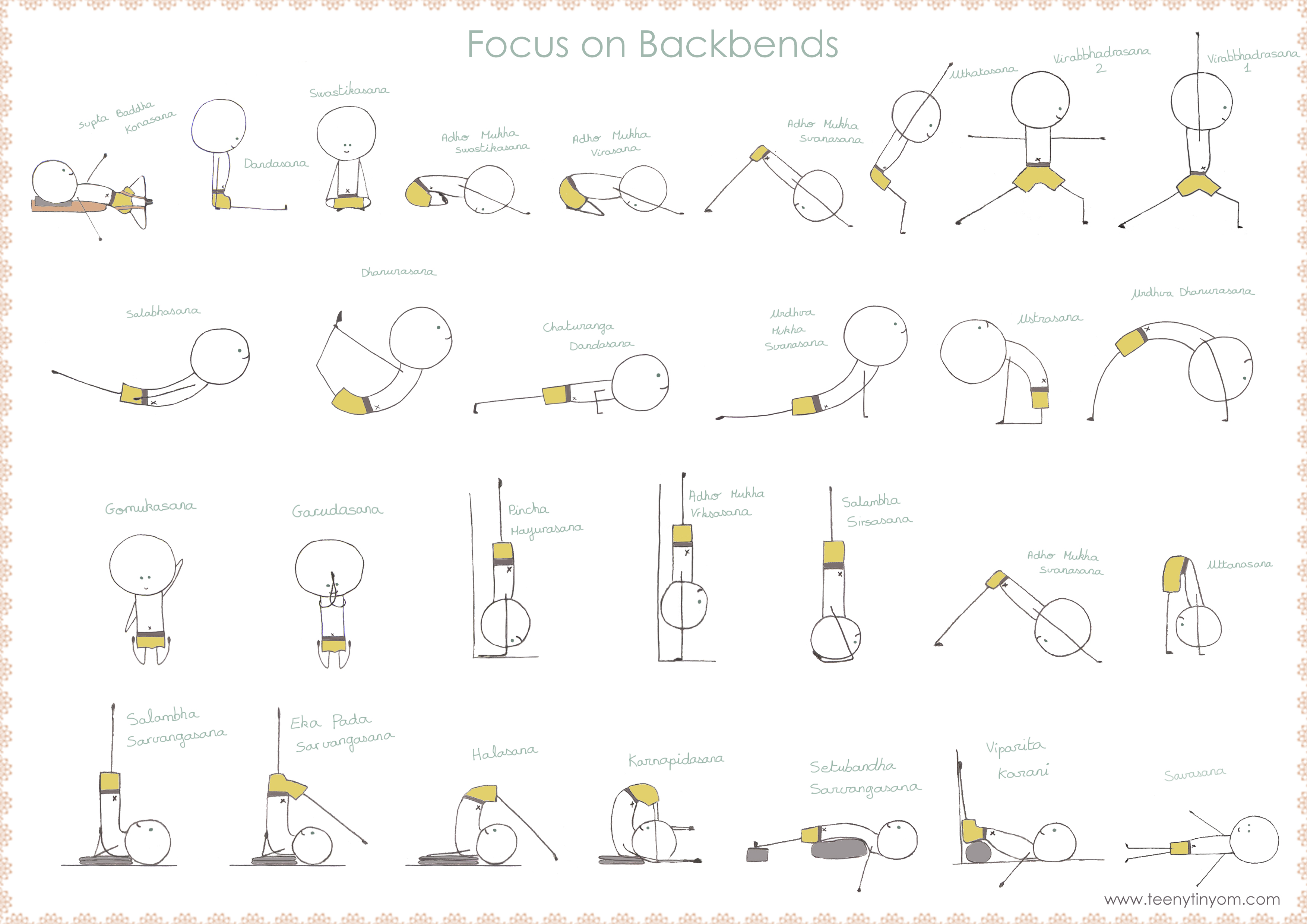
While looking for an image for this blog post, I stumbled upon this excellent yoga blog with great sequences and cute drawings! I alrea...
-
 Alright, I feel like going back to the beginning of The Tree of Yoga, (Note: I used "tree" in the blog title because of my nickna...
 -
 I'm trying to start practicing 6 days a week, but its hard since I work so far away and don't always get a chance to stop by home t...